Gold? Silver? Bitcoin? What about Dogecoin?!?! Sure those will work. Well, OK, not that last one, no matter what Elon says.
But let’s talk about something else. Something we can do to hedge every time we go to the store. Something we should all be doing anyway.
Shop by unit price. This may be something many of you do already, but for those of you who don’t, here is a quick crash course.
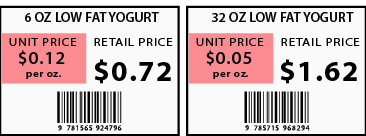
That number in orange is the one we want to look for. That is the unit price. The unit itself may vary. Depending on the product, we could be looking at pounds, ounces, or even sheets in the case of paper goods. As long as we are comparing apples to apples in pounds to pounds, we are going to see the the difference pretty quick. And no, in this case a pint’s not a pound the whole world round. Make sure we are looking at the same units!
Once we are looking at the same unit, the better price is self evident. So that’s it, right? Just buy the bigger one to get the better price.
Yes.
Well, maybe.
We still need to be smart with our budget. Shop by the best unit price on everything and we may well have a heart attack at checkout. In the example above, the unit price on the right is a thing of beauty. But that retail price? That is 2.25x more. If it fits in the budget, great! Then we are still going to buy the bigger one and get the better price, right?
Still maybe.
Look at what we are buying above. Yogurt. We all know what happens to yogurt once it is opened. Like Marisa Tomei, that ol’ biological clock is ticking. If we can’t use 32 oz of yogurt before the buzzer, we are not saving money. Let’s say we only use 8oz of that 32oz and the other 24 spoil. Our unit price becomes a rather ugly 20 cents per ounce. We have to use 13.5oz of that 32oz container just to get the same 12 cent unit price of the 6oz container. We don’t save money until we can use 14oz, and the realized savings get better from there.
OK, so we look for the best unit price for the amount that makes sense for our immediate needs.
Almost there.
Story time. Yogurt spoils. But laundry detergent doesn’t. This week, I realized I was down to my last backup bottle of laundry detergent, so it was time to stock up. I figured I would buy once cry once, so I did some math. Targmart beat my local wholesale club price by a fraction of a cent. And there was no difference between the 92oz bottle and the 154oz bottle, in terms of unit price at 13 cents. So I could avoid a heart attack by buying the smaller bottles and not lose money.
Except. Except there was a deal on the two largest sized bottles. Buy 3 large bottles and get a $10 gift card. Now if we factor that in, the real price is just under 11 cents an ounce. And knowing that laundry detergent is something we will need and won’t go bad, I bought 6 large bottles. I paid up front and I effectively got 154oz of detergent for free.
So how does shopping by unit price hedge against inflation? We use unit pricing to get the most out of every dollar spent today on the things we will use now and in the future. Inflation is going to cause causing prices to go up. We must maximize the value of every dollar spent and push that value as far into the future as we can. Yogurt may not store, but a lot of food will. Canned goods. Rice, sugar and flour if properly packaged. Meat properly packaged and frozen.
If it is a staple in your pantry, buy more for your money with unit pricing now, so you won’t have to buy less with inflated dollars 6 months from now.
Also, keep an eye on that unit price. it will tell you the truth of what inflation is, better than any talking head on TV.
 Prepared To Cook