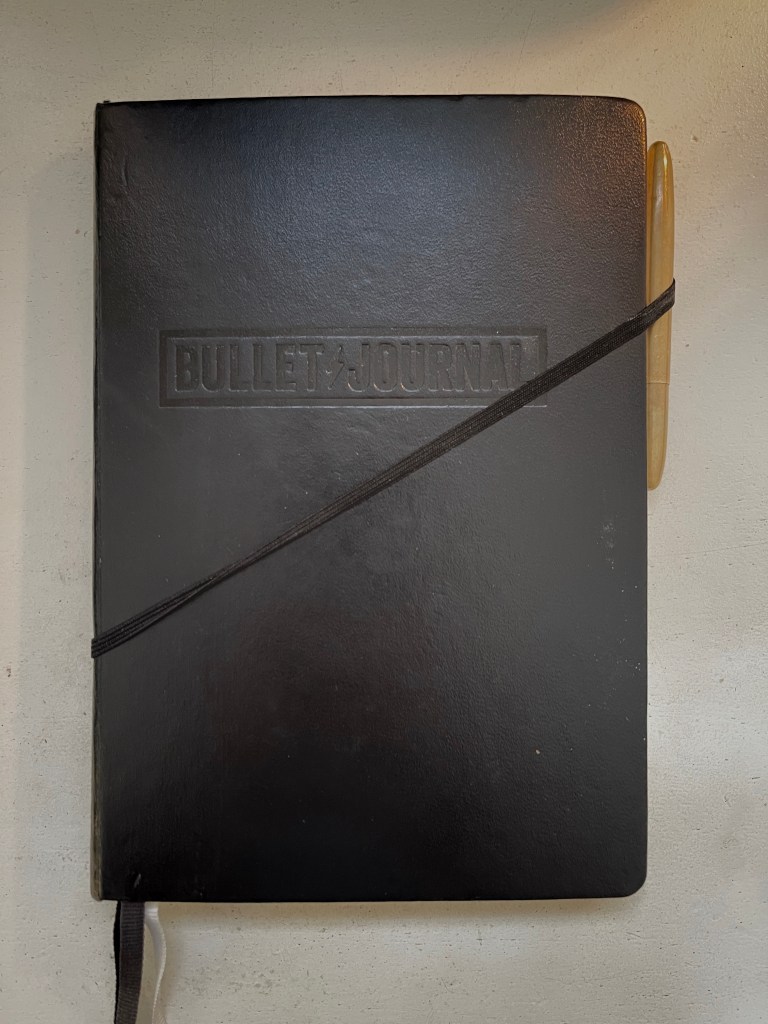
About a year and a half ago, I started journaling as a way to help keep my thoughts straight. It wasn’t really meant as a food journal or inventory, but over the months I have added and tried different ways of doing things and keeping track of what we have and need.
A lot of things clicked when I encountered the Bullet Journal Method by Ryder Carrol. I cannot recommend it enough if you are thinking about starting your own journaling practice. I won’t go deep into it here, except to say that the sheer flexibility of the system is what has allowed me to do so much for getting prepared. Here I’ll touch on several of the ways I use my journal specifically for keeping on top of various components of my preps.
The Food Journal
As I mentioned in one of my earlier posts, a good way to figure out what you need to keep in stock is to track what you are eating. I simply keep a page where I can log what I have eaten through the day. I don’t get too specific with it. I am not tracking to calories specifically, nor am I tracking the entire family. But it gives me a pretty good log of what is going out, so to speak.
To be honest, I have never been all that great at keeping a food journal, I try to keep it to manage what food is going out, and to see how I am doing from a diet perspective (really could be doing better on that front), but I use it more in a general sense. It let’s me identify some trends like, “a lot of tuna for lunch” or “steak and vegetables is a very common meal, keep that stocked up”. That sort of thing. I do try to combine it with a weight log so I can try to keep myself heading in the right direction, but that is very much a work in progress.
Ultimately, this is probably best thought of as a big overview of what my diet looks like.
The Inventory
This is one of the single best additions to my journal. It is simple in the set up, but it has allowed me much greater control in how manage our stock. I keep my inventory very simple, which is allowed in large part by the format of the bullet journal itself. On the left, I keep a column wide enough for the names of my food. The balance of the page is a held for tracking. Each dot represents a particular unit of that food. The units can vary. Flour is packaged in such a way that I consider each dot about a week’s worth of flour in regular use. Rice on the other hand is stored in 8 cup portions as that fills up a half gallon mason jar for storage in the pantry. I always leave at least two rows per item so I can have space to track a large number of ingredients.
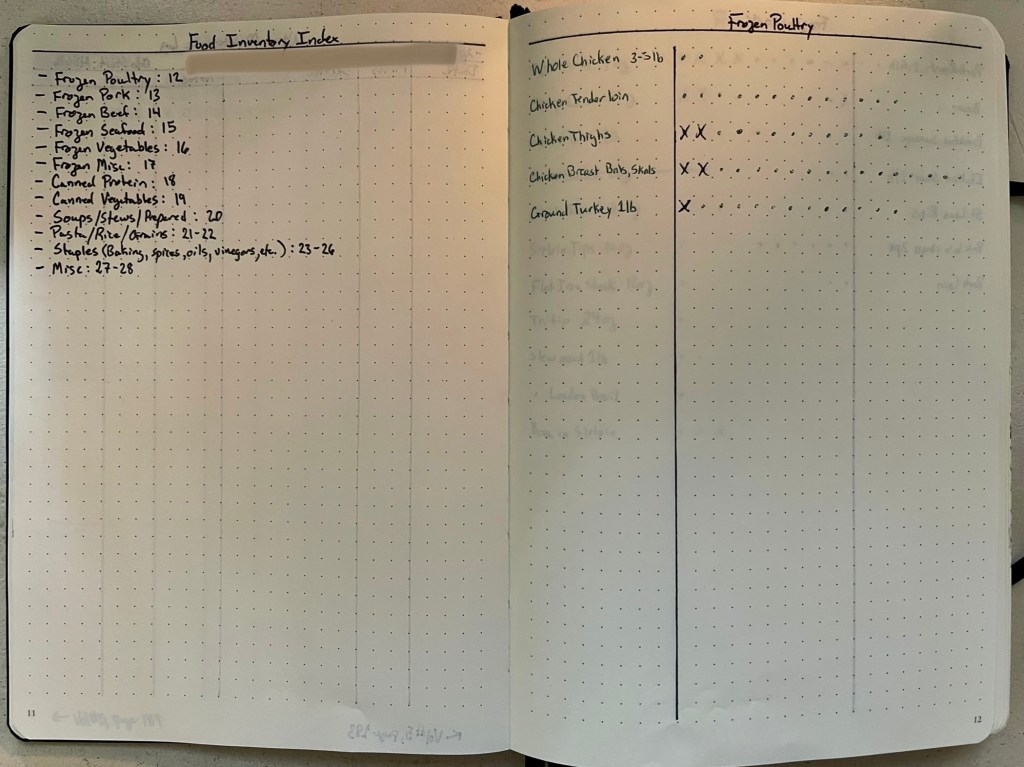
So as I went through my pantry and basement stock and organized, I wrote down the item and put a dot for each one I had. If I buy more at the store, I just add dots to the end of the line. When I use an item, I x out a dot at the start of the line. This lets me continuously add and subtract inventory as I go. We have been using Butcherbox for our meat for over a year now. Keeping inventory this way allows me to go in before each box ships and see how much, of what, we have used, what we really need more of and what we don’t need to order this time around. When the box comes in, I add the appropriate dots, and cross them off until the next box. In this way, I have managed to balance out what we have and to keep up with the things we use and eat more frequently.
I have a tendency to make things overly complicated and then get overwhelmed and wander off. This dot and x method of inventory has proven to be very simple and effective. I have consistently used it over the past 7 months with great success. Yes, the inventory will get a bit out of whack over time, but, at least with the Bullet Method, there is a bit of a fix for that. This year at the 6 month mark, I had pretty much filled my first journal for the year. It is at that point that I migrated to a new journal. That process of copying over the items from the old journal to the new is the point to do an inventory. It took nowhere near as long as the initial set up because the organization was done, and I could count very quickly. Yes, there were some gaps or inconsistencies, but there were quickly caught in the recount. A couple hours of counting and listening to podcasts had it taken care of.
The inventory is the core of my food tracking system. Combined with the next, extremely simple piece, shopping for what we need is simplified even further.
The Shopping List
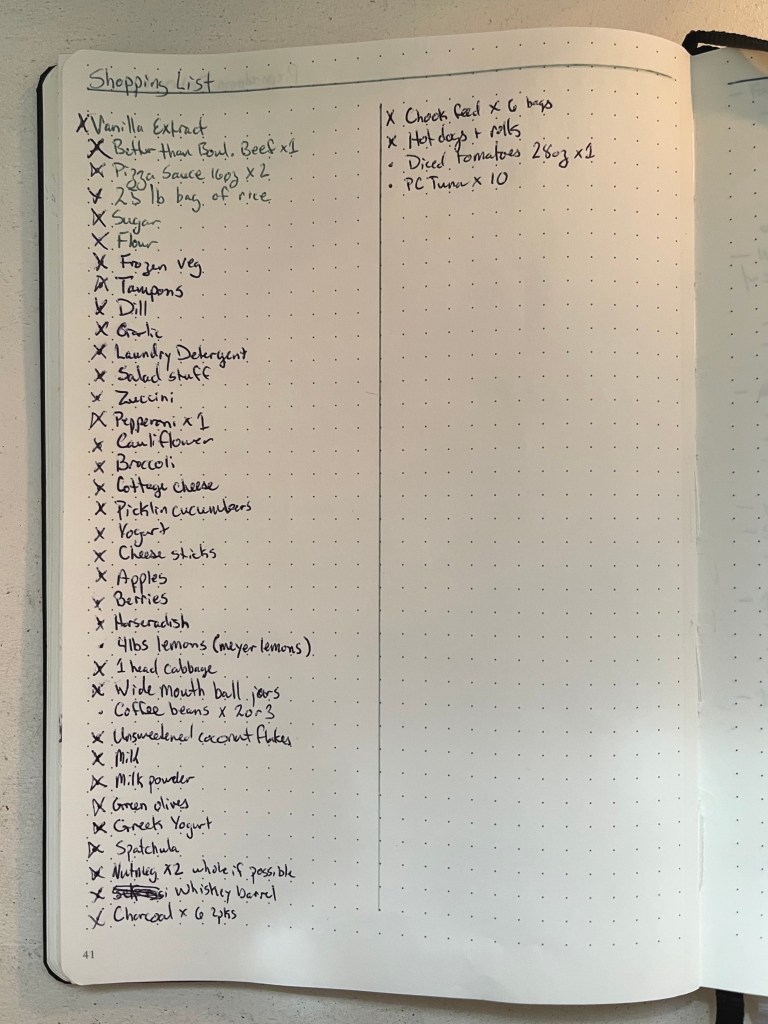
I probably don’t need to go too in depth on this. I just split the page into two columns and write down what I need when. Each item gets a dot in front of it, and just like the inventory, when I buy it, it gets x’d out. But don’t let that simplicity fool you. There are actually some real benefits to having a persistent list to look at and review.
First, by the simple fact of using the task notation (dot and x) of the bullet journal, I can keep track of things that I have not yet bought, even if other things get added after them. If I mark down, say, flour, and go to the store and cannot find any, well it stays there. I buy what I can, and as time goes on, I add more things to the list. When I go next time, flour is still there, not crossed off and I can look for it. Keeping the list in one central long running place means nothing gets lost or forgotten.
Second, there is real value in having a long running list going. You can go back through the list and see what you are buying generally, what you are buying often (consider increasing quantity on hand) and what stays on the list for a long time (let’s you know what is becoming scarce so you can get more than normal when you have the opportunity). All of this data builds a picture of where you are focusing and where you need to keep your eyes peeled for opportunity.
Inventory and Shopping List Combined
This is where it all comes together. When I go out to pick up food, I am working off my shopping list. Doing so keeps me from wandering and buying all sorts of things that I may or may not need. But at the same time, as I am going up and down the aisles, if I come across a deal, I can check to see what I have on hand. If I feel I have enough back stock to last a significant amount of time, maybe I will hold off. But if I see my inventory is just OK, maybe I take advantage of that sale and really stock up to save and build. Additionally, if you are a flyer shopper, you can grab the current flyer, compare the sales to your inventory and then just put the specific sale items on your shopping list. That way don’t even have to scroll through the inventory while shopping.
There is real power in this combination. On the fly, in the store you can react to changing inventory conditions. Your shopping list can be built off of real knowledge of what you have, based on any sales you are aware of. But having your inventory on hand while shopping means you can react appropriately to those sales you aren’t aware until you are at the store.
Miscellaneous Prep Information
The freeform nature of the bullet journal means you can use it to house all kinds of information about your preps. Jot down the date of a good sale in your calendar. Copy that really great recipe you found. Remind yourself that you don’t need to salt the eggs when you are putting in ham to boot. Jot notes about what the store shelves looked like while you were out, perhaps something was missing that you weren’t looking for, but you want to keep tabs on. Maybe you make a note that the price of milk went up by 10% since the last time you bought it. This is all important data to keep on hand for future reference. You don’t know what may or may not be important down the road. I use my journal daily for everything. It was never meant as just a prepping journal. I have gained a lot during the past year plus just by being able to get my thoughts out on paper.
A final note
Can this all be done electronically? Sure. I can only speak for myself, but I didn’t find great success there. First, it takes different apps or programs to do that. I had my shopping list on my phone, inventory in a spreadsheet on the computer, and that was ignoring the fact that I hated the idea that I was putting information about my diet on the servers of some other entity. Plus I have a bad habit of getting lost in garbage when I use my phone. When I made the switch to a good ol’ journal, all of that went away. It is a single, central, private collection of my critical information.
Give it a try, you may not like it, but for the cost of a cheap journal, you may find a system that let’s you put some order to chaos. And if you are already using a system, let me know what it is. I am always looking for arrows to add to the quiver.
 Prepared To Cook